|
| |
KITES
General
Kite Info and a bit of tech
This Page:
Almost everything you want to know about kites. (in general)
Designs:
Inflatable and foil, "C" Kites, Flat / Bow Kites, Hybrid Kites
Configurations: 2 line, 4 line, 5 line
Aspect ratios,
Sizes from 2m to 20m! How to choose.
Brands: Which one make the best kite?
Beginners: Be sure to visit
our Trainer
kite and Traction kite page.
What's the Best
Brand to Buy?
Airush, Best, Cabrinha, Caution, Eclipse, Flexifoil, GK, North, Naish, Ocean Rodeo,
Ozone,
Takoon, Wipika,
Fact: Almost all of the manufacturers make a great kite. Its more
important to choose the
correct kite model within your favorite brand for your skill level and needs.
Things to consider when choosing a kite:
- Size: Factors: Skill level, body weight, average winds
in your are
- Aspect Ratio / Design
- Year Made Kiteboarding is a new sport and each year
brings major design changes.
- Guarantee, Warrantee, and the companies reputation for customer service.
- Price: This is a biggie for most people.
- Usage Will it mainly be used for water or land sports: Kiteboarding, or
SnowKiting?
Inflatables and Foils
These are 2 very different types of kites.
Inflatable Kites
are ideal for Kiting on Water
They float and fly great wet or dry. Designed with internal air
bladders
an and outer skin. These kites need to be inflated using an air
pump,
to gain the required pressure to become firm.
.
The
leading edge (front) of the kite has a large inflated tube that is filled
up
using an air pump. The "Leading edge Bladder" along with the
"strut bladders"
(Tubes)
maintain the shape of the kite.
Excellent kites for the water, but
generally not designed to handle repeated impacts
with land.
Foil kites: Ideal
for Kiting on Land.
Foil kites are more durable and thus recommended for Land based Kite-Sports
like Snowkiting, Kite Landboarding, and Kite buggying.
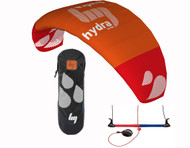
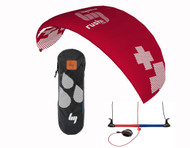
Foil Kites the common design used for trainer kites,
and traction kites maintain
their shape by the numerous "bridal
lines" attached to the bottom surface just
like the lines on a parachute.
Foils self inflate as air flows into air intake opening
along the leading edge.
As the
kite flies forward, the air is "rammed" into the openings.
Thus the term "Ram Air Foil". Foils are normally the preferred
choice
for use on land due to their ability with handle impacts, their light weight, and
quick set-up without needed a pump.
Learn all about the various foil
kites on our Traction and Trainer Kite page.
Brands: Common
question.... "what's the best brand?" Answer: There
several excellent ones.
For 2007, all the
kites look great, most of them fly so well, you may find
yourself choosing a
brand based on little things like its Color! The most
important thing is
to choose the right model within a brand. 2, 4,
or 5 lines,
low,
moderate, or high aspect, standard "C" shape, or "Bow / Flat Kite"
are the critical decision.
More info on buying,,, buyer beware.
Links to the Kite
Manufacturers websites: **Caution: Much of what you
will read on their sites is
marketing hype. Everybody thinks they have the
greatest kite on the
market. After over 3 years of riding various kites, the
truth is that
there are way more similarities than difference and most of
the major brands are
excellent kites. Most importantly, your "first"
kite should be
easy
to re-launch. Beginners should select a low to
moderate *Aspect Ratio.
*Aspect Ratio:
known simply as "AR" is the basically length divided by
the
width. Example a kite that is 25 ft long (wing tip to wing tip) and
5 ft wide .... 25/5 = an
"AR" of "5" Most kites are just known as high,
low, or moderate "AR's".
High AR: Long and thin Looks a bit like a ribbon in the
sky.
Moderate AR: Not as long, and thicker in the center, Like a
Beach towel.
Low AR: Short and Fat.
High AR Kites:
These kites are long and thin.
Advantage: Upwind Ability, and Hang-time during jumps, overall
highly efficient and aero-dynamic.
Older High aspect kites were very difficult to fly.
They can require more skill to "re-launch" from the water,
because they need to balance themselves on a narrow wing-tip
in the "edge-of-the-wind" launch position.
Main advantage: Upwind performance.
Main dis-advantage, tuning ( line adjustments are more sensitive).
Low to Moderate AR Kites:
These kites are the easiestto water re-launch after you crash and
thus easier for beginners, and advanced riders as well who are constantly
trying new moves and dumping they kite in the water, thus needing to
re-launch more often.
Wake style riders, and wave riders many times prefer the this type
of kite because it sits a bit further back in the "wind-window" and creates
a more constant pull.
Lowering the Aspect ratio also means the wing-span is shorter,
which allows a good kite to turn faster. (more responsive).
Moderate AR Kites are ideal for most people because they
fall right in the
middle of the pack. Versatile: A kite that does it all.
Fast turning, upwind, tricks, and perfect for the the surf, a kite that
relaunches quickly before a waves thrashes may
save you a trip to
the repair shop.
2 line is pretty basic, one line on the
right, and one line on the left. plus
a cross-over bridal system.
2-lines on small trainer kites are welcomed.
On inflatable, 4-lines is the only way to go.
Basic 4-line "sheetable-kite" depowering system.
How it works:
Shortening the FRONT LINES, pulls down on the front ( Leading edge
)on the kite.
( Called sheeting-out)
Lengthening the BACK LINES, allows the back (trailing edge) of the kite
to open. (Sheeting out)
Yes!!! You are reading this correctly!
DEPOWER:
There are 2 ways to cause your 4-line kite to sheet-out and thus "depower"
(loose power).
Shortening the front lines
or lengthening the back lines.
The EXACT same outcome.
Now.
If you Lengthen the FRONT Lines, the front of the kite will move further away,
which means the back of the kite will become "relatively" closer, and create
MORE
Power.
POWER UP
Lengthen the Front lines or Shorten the back-lines.
There are many ways to adjust the line length on newer kites.
Adjustment knots at the bar end
Adjustment knots at the kite end
Depower: Adjustment strap.
Moving the bar closerr or further from your body if your are connected
(harnessed)
to the "chicken-loop" ( trim loop)
If this sounds confusing,
no worries, it will become crystal clear during your
lesson with a certified
instructor.
----------------------------------------------------------------------
Basic 4-line Inflatable, or 4-line "sheetable" foil kite line connections.
2-lines connect from the outer ends of the control bar (outside lines)
will connect to the
(trailing edge) of the kite, one R and one L.
Another 2 lines connect from
the Front of the kite (leading edge)
connect to the center line near the bar, that pass through the center
of the bar and
then connects to the "trim loop" (aka chicken loop).
_____________________________________________________________
NOTE:
4-line "Standard" foil kites mostly (if not all) connect up Opposite
that described above. Refer to the manufacturers Manual for your specific
kite.
__________________________________________________________________
Angle of attack
Changing the length of the back "or" front lines causes the angle of the kite to
change, very much
like adjusting the sail on a boat.
Shortening the front lines causes the leading edge move closer reducing the
"angle of attack"
and decreases power.
Lengthen the
Back lines, does
the same thing. In sailing its termed
"sheeting out".
Lengthening the front lines and/or Shortening the back lines both result in
"increasing power".
This is called "sheeting in". You should also understand
that if you sheet in, too much, you can
"over-sheet" the kite to the
point where it will loose power (stall) and even fly backwards.
With Sails, and kites...
more Power, DOES NOT. always equal more speed or
performance.
If the back lines are too tight, you will feel power, but you will also
loose "lift" and create more
"drag". ( aka a kite that flys really bad)
More power Does NOT, always mean more speed, or better performance.
Its possible to "OVERSHEET" the kite, to the point where you will loose lift,
power,
and forward drive.
In short:
Decrease power = sheeting out = lengthen back lines and/or shortening front lines
using the
"depower-strap"
Increasing power = sheeting In = Shorten back lines = Lengthen front lines via
the
depower-strap.( lines length can be adjusted in more than one way, but the net effect is the
same).
4-lines also help the
turning speed on big kites. A 4 line kite is NOT any more difficult to
fly, because
you can use it like a 2-line and just pull right and left.
The 4-line does bring more responsibility when
connecting the lines. You
will need to remember the correct place to attach your lines. This is
easy,
if you have a system, and double check the lines before launching your kite.
I now teach beginners on 4-lines right from the start!
Here is a way to remember it. The name of a popular restaurant "
Outback
steak house". "Out-Back" The lines from the Outer
ends
of the control bar ( out) connect to the Back (trailing edge) of
the kite.
Here is another way to
remember: The best place to stand on a stage
is the "Front
and Center". The lines from the center of the control bar need to
be connected to the
front (leading edge) of the kite.
Inflatable Kite Sizes:
The size you choose depends on your Skill level, body weight, & local wind
conditions. Most manufacturers market their kites based on
"total (Flat) area". In '01, and '02
some kite were
sized based on "projected
area".
Projected area multiplied by 1.36
will give you the approx total area.
(or.... total area divided by 1 . 36
will give you the total area). This calculation is not even a
standard but its helpful. Yeah, I know... its
confusing.
Example:
Here
in Florida, our summer winds are usually in the 10-15 knot
range. In these
conditions, an average weight, 140-180 lb beginner would fly a kite like
a 17m (flat size) A light
weight rider (petite ladies and kids) might use a
13m ( 12 meter
flat size), and an advanced
Rider
might choose to fly a HUGE kite like an 18-20m. I recently
gave a lesson to two guys, both weighing
around 240 lbs. "These"
beginners used the 20 meter! For them it was the perfect size in light
winds.
**Eventually, you will end up with
2 or 3 kites, and its WAY SAFER to begin with a smaller one first.
( These numbers are based on my experiences as an instructor using a 180cm
board, and generally
warm, light florida winds) Colder
air is denser and has more punch.
Warmer air and high elevations mean less
punch for a given wind speed.
The wind speeds of 10 & 15 knots sound close, but in reality, there is a
huge difference. If you are
not sure which kite to rig, go small as a
beginner.
Avg./ lightweight Ladies: (100-125 lbs) your first kite will likely be
smaller than those listed above.
Your instructor or retail guy ( who
actually rides) can assist you with this.
**** Body weight, local wind conditions, and board size are all
factors when choosing a kite.
Variable Aspect ratio:
Translation.... The kites are NOT just scaled down in smaller sizes. The
designers change the relationship between the length and width of the kite (AR)
for each kite size.
AR goes up as kite size goes up. Don't be too impressed when you
read this piece of marketing info
because all of the 2002/2003/2004 kite designs use
it and adjust the words a bit to impress you.
Beginners:
start with a Trainer kite in the 2-3 meter range, practice flying it until
your movements
become instinctive. Steer a kite like a waverunner or
mountain bike. One arm in, one arm out. Just
like a bike handle bar (NOT like steering a car).
More flying instructions on the "how to"
page.
Next.. take a lesson, and get hooked up with your own gear.
All-Terrain/Mountain
Boarders/ SnowBoarders/ other "land sports"... On Land, a
"foil" kite is the
way to go because you don't have to be concerned with getting a small
hole (air leak) in the kite.
Click
here for the Foil kites: Trainers and Traction kites for land based
sports
Foil Kite sizes:
Foil kites are extremely efficient for their size compared to inflatables.
Ex: In 12 knots, I ride a 16m 4-line inflatable, or I could also use a 9-12m foil.
Buying the wrong gear will only frustrate you.
Kiteboarding Instructors are in most cities around the
world.
So get a lesson, get some gear, and get out there!
Where to Purchase
Gear: Kitemare.com is a good place to start.
Warning: If someone tells you... " this__________, is the "only" brand worth
buying and everything
else is junk", take your credit card and run!
ONLY buy from retailers who actually Kiteboard and have a passion for the
sport. ONLY buy from
retailers who have CERTIFIED Instructors on staff.
Shop around: Some retailer make you THINK you're getting a great deal on
close-out gear, when
you could have bought BRAND NEW gear for the same price.
Guilty shops... Yup, we have one nearby, but I can't seem to
remember their name. ???
Trainer Kites: Click here to visit our Trainer and Traction Kite Page
Buy from someone who you feel will give great SERVICE and VALUE.
Just avoid the posers who are "only" in
kiteboarding for the money and don't care
about maximizing
YOUR fun factor.
At Kitemare.com, Our
goal is your goal. We want you to learn fast, kite safe, and get the Best gear
for the best price. ....On any brand you want!
If we do sell it
via this site, we'll put you in direct
contact with a reputable retailer who will
provide you with the price
and service you're looking for.
|