|
"How-To..."
Learn it here:
Terminology, Techniques,
Challenges, and Solutions
For Foils Trainer Kites, Traction Kites,
and Inflatable Kites
This Page:
Terminology
Trainer and Traction Kites:
Set Up,
Connecting and adjusting lines
Line maintenance: Sorting, checking, correct wrapping to avoid tangles
Launching, relaunching and landing
Basic Terminology you should know:
Foil Kite
Inflatable Kite
"C" Kite
Flat / Bow Kite / SLE Kite
Leading edge
Trailing edge
Upwind
Downwind
Wind-Window
Edge of the window
Power zone
Off-shore wind
On-shore wind
Side-shore wind
Side-Off
Side-On
Control Bar
Figure 8 line wrapping.
Handles
Safety Kite Leash
Leader lines
Flying lines
Brake lines
Harness line
Larks Head Knot
Harness
Spreader Bar
Chicken-loop / Trim-loop
True Wind
Created Wind
Apparent Wind
Mph, Knots, Kph
Clean wind, Gusty wind
Sheeting-In, Sheeting-Out
Stall
Trainer &
Traction Kite Set-up
Flying practice: exercises and skills to learn.
Adjusting line length
on a 4-line kite , & Line extenions
Inflatable Kite Set-up
5th Line Set up (best kick 5th upgrade kit)
Safety Leash set-up and adjusting
If you don't find the answer you are
looking for here,
Contact Us with your questions.
This website was designed for You. Let us know how we can better meet
your needs.
Our goal is pretty straight forward, we want you to...
"Learn fast, kite safe, get amped, go huge, and share the stoke!" -
Jeff Weiss / Kitemare.com
Trainer Kite (Foil
kite) Set-Up and Flying.
Kite Manuals by Brand.
Best Kiteboarding Gear Manuals ( 3m Trainer, Waroo, etc)
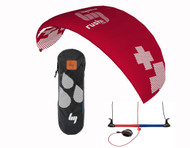
HQ
Beamer TSR
FOILS ( trainers and kites
used for landboarding or snowkiting)
Proper set-up & launching:
Pick a wide open area free of
obstructions ( trees, powerlines, etc), and a safe distance from people.
Pick a location with Clean Wind (Avoiding obstructions that
block, or re-direct the wind flowing
toward your kite.
Lay your trainer kite on the ground with the bridal lines facing up
and be sure the
"trailing edge" ( back end of the kite, sewn closed) is facing
"up-wind"
If the terminology is confusing, think of "up-wind" like
"up-stream" or "up-hill")
Weight down the trailing edge with sand, dirt, or small rocks.
(only weight the trailing edge
of the kite to keep the wind from blowing under it).
Leading Edge (Front) notice the openings. Trailing Edge:
Being weighted down with sand.
Once you Kite is Secured and unable to blow away,
UNwrap your lines, and
connect the lines ( if not previously
connected) using a "Larks Head Knot"

Connect:
"Larks Head knot" ready for "Bridal point Attachment"
> Attached > Tightened
VIDEO Clip: Connecting your lines. "Larks Head" to "Bridal
Point"
Locate the Bridal Point attachments, un-tangle them if necessary, and
separate them ( right and left)
Connect the flying lines ( the ones than come packed on the plastic
winder) to the "bridal points"
with a "larks-head" knot (larks-head is a fancy name for a basic
slip-knot)
Photos: Making a larks head knot from a loop, by folding the loop over
the stem.
Lines wrapped in a figure "8" pattern on the bar.
Unwind your lines from the winder as you walk upwind, away from
the kite.
Leave the lines a bit slack on the on the ground so you don't
accidentally cause
the kite to launch.
Separate your lines, removing any twists, so that you can clearly
see the right & left lines lying apart.
Position the "control bar" so that the logo reads left to right
as you look down-wind toward your kite.
Red line on the Left.
Connect your "flying lines" to the "leader lines" (leader lines are
heavier lines attached to the control bar.
Review these instructions an double check your set-up, BEFORE, launching
the kite.
Launching ( a trainer kite /
Foil Kite )
Connect the safety leash to your wrist.
If wearing a Kite-Harness, you'll also have the option
to connect the safety leash directly to your Harness.
Note: Do NOT use or even wear a harness until you have first mastered
basic kite flying skills.
Pick up the control Bar

Red on your Left.
Now..
Open your hands and "RELEASE" Yes, Drop the control bar...
RELEASE!!!!.
Next...
Pick up the control bar, Red-Left....
Next...
RELEASE!!!!.
You NEED to PRACTICE, " RELEASING " the control bar.
Do this Control Bar "Pick-up and RELEASE" atleast 5 times
and get it wired into your "muscle memory".
This is NOT a joke, Practice this exercise.
You would be amazing at the % of people who freeze-up in an
emergency, and
lock their grip onto the bar, even as they're getting dragged down the
beach!
RELEASE! A properly rigged safety leash will "Kill the kites
power", and also
keep the kite from getting away.
Walk back to tighten the lines until you see the "leading edge"
of the kite lift up a bit.
like the back on a chair
Hold the bar, level to the ground.
RED side of the bar (or red lines) go to the Left.
Blue / Black / Yellow / or Green are used on the Right
Give a tug to dump off the sand or dirt and ..... up she goes!
Keep the bar level to the ground and steady.
Your initial goal is just to launch the kite and keep as close to a
"12:00" position
as possible with very little movement.
Picture a Huge Kitchen wall clock. 12 is at the top. 6 is
straight down.
9:00 is out to the side of your leftshoulder. 3:00 is out to the side
of your right shoulder.
Skills... to practice with your
trainer kite
STEERING
Steering a trainer kite is like steering a mountain bike, or a
wave-runner,
its a push-pull movement, keeping the bar level to the ground.
One arm extends, and the other arm bends.
A Common Mistake is tilting/ turning the bar, hand over hand,
like a car steering wheel ...
NO ,
Think STEER like a "MOUNTAIN BIKE" or Boxing, one arm out,
and one arm in.
Pull (bend your right arm) to turn the kite to the right. ( just like
steering a bicycle)
Sure, you "can" angle the bar for comfort, but the kite ONLY understands
Tightening
one line and slacking the other. One hand IN, One hand
OUT

WIND WINDOW
This is the area of the sky that you fly your kite in.
I like to picture it as a giant Dart Board and clock combined.
SLOW MOVEMENT
Once you can maintain a 12:00 position ( straight up overhead
also called neutral),
its time to get brave and move your kite slightly to the right to a 1:00
position,
and then s l o w l y back to 12:00. Small, slow movements.
SLOW and PARK
Now practice "12 to 1" and then "1 to 2" and back to 1 and
back to 12.
Initially, keep the right flying only straight up at 12 or slightly off
to the right side of
"the wind window" (like 12:30)
PARKING
Practice Holding your kite Steady at a designated position between 10
and 2.
Pick only "1" position, and learn to keep the kite as steady
as possible in the
sky avoiding quick movements. Keeping the kite in a steady
position. This skill
will help you learn to keep the kites power to a minimum. Minimal
power is desired
when putting your feet into the footstraps, strapping into your
snowboard bindings,
or walking upwind while flying your kite.
Practice slowly bringing your kite to
the far edge of the window and then hovering
it about 3 feet ( a meter or so ) above the ground. This position, the
"edge of the window",
is where you'll eventually be launching and landing your "Inflatable"
kite, when the time comes.
Remember: This is a training
kite... ideally to train in preparation for Kiteboarding,
Snow-Kiting, or Kite-Landboarding.
POWER ZONE
Think of the Wind window and Power zone like a giant dart
board.
More Power and More Points near the center.
The outer edge of the window = minimal power ( or minimal points
on the dart board)
The center, bulls-eye, has max power ( like max points on a dart
board).
This is the "power zone"!
Imagine a vertical line from 12:00, straight above your head,
down to 6:00, The Ground. This imaginary line divides the flying
area (aka wind window)
into 2 halves, Right and Left.
Practice flying the kite in only the right half of the sky,
From 12:30 over to 3:00.
and then
Practice flying only in the left half of the wind window
11:30 over to 9:00.
Notice I didn't say 12 to 3, or 12 to 9,
but rather
12:30 to 3, or 11:30 to 9
The reason is safety, to give you a buffer zone, so that you avoid cross
the 12:00 line.
Crossing sides of the window, like using figure 8's or "10 to 2"
patterns,
is fun with a small trainer kite "when" you want to feel more power.
But...
The figure 8 across 12:00 pattern will pull you down-wind is a big hurry
when you're on
the water. Yes, you should learn how to do it, but focus on
keeping the kite to one side
of 12:00 is safer,more practical, and the only way to go " Up-wind"
while riding.
PRACTICE PRACTICE PRACTICE
12 to 1, 12 to 2, 12 to 3. Each time returning to the 12:00
position.
One you wire that, go back to 12, and practice the same skills on the
left side only.
12 to 11, 12 to 10, 12 to 9, back to 12
SIMULATED RIDING
Kites feel and respond differently when you are moving at speed across
the
Water, Sand, or Snow than they do while you are standing in a fixed
position.
MOVING / WALKING / RIDING TO THE RIGHT
Walking to the right,
perpendicular to the direction of the wind.
Not upwind, Not downwind, but ... Across the wind.
Gentle up and down movements with the kite (12:30 and 3:00 )
as you walk to the right.
YOUR FIRST SIMULATED TRANSITION
Stop and change directions: Moving Right to Moving Left.
while walking to the right
Slowly bring your kite up to the 12:30 position, and stop walking.
Look to the Left in your new desired direction.
Spot a location that's perpendicular to the wind on the left side.
Direct the kite to the new side of the wind, 10:00, and start walking to
the Left,
moving the kite in the same gentle up and down flow to the left. 9
to 11
MOVE IT FAST ... FEEL THE POWER
Learn to adjust the power of your kite while moving.
Using the same walking Exercise above.
This time you'll be moving the kite at steeper angles.
Going to the Right, you can try a 1:00 to 5:00 dive.
The steeper and longer the dive (aka power stroke) the more power is
generated.
For less power,move the kite in small more gentle movements.
RIGHT - RIGHT or LEFT - LEFT
Just be sure to
keep the kite to the Left side of 12:00 when move to the Left.
and keep the
kite to the Right side of 12:00 when moving (walking or riding) to the
Right.
<<< F left 12:00
right F >>>
SLOW & SAFE or FAST & FURIOUS
Fast Kite movement that cross over the 12:00 line can kick your butt
in a big way. Similar to driving your car at 30+ mph, and then slamming
the shifter
into Reverse without slowing down!
DE-RIGGING at Foil Kite
(Trainer Kite )
When your done for the day... I
recommend leaving everything connected.
2-Line Kite
Take one of your lines, and wrap it in a "figure 8" pattern onto the
control bar. If your kite is 6 feet long, wrap up
6 feet of line ( only one line) approx 3 wraps if your control bar is 2
feet long. ( 2- foot bar X 3-wraps = 6 feet )
Wrapping the lines asymmetrically is done to keep the kite
depowered and prevent it from launching. After
the 3 wraps, go ahead a wrap both lines until you reach the kite. (On a
larger kite, more wraps will be needed)
Lay the kite "belly up"Bridal lines on top. fold the kite like folding
dinner rolls in a cloth napkin to keep the lines hidden.
Put a rubberband on the end of the bar to keep the wrapped lines
in place.
Put it all in your Kite Bag, Kick back and relax.
Harness Line: How to connect a harness line to your bar.
We'll be adding a video on for this one. Too many words to type.
Adjusting line length
on a 4-line kite.
While is flight, the back lines should look slack.
The load should be on the front lines.
If your back lines are too tight, you'll find the kite not wanting
to go upwind easily and may also see the kite try to fly
backwards out of the sky. This is because the kite is stalling,
or some call it , back-stalling. Quick fix: Lengthen
the back lines or
shorten the front lines. Either method with yeild the exact same result!
How to make a line extension

"Flying line" thin lines ranging from 20 to 30 meters,
which normally have a sleeved end used for making your
"larks head knot"
"Leader Line" ( shown in grey) A heavy (thicker) line than
originated at the control bar.
Photo above: Flying line connected to the leader line. Notice the
extra knot in the grey line. If you loosen and move your "lark-head"
to the 2nd knot, you will be "shortening" your line.
If you find that your line is still "Too short" even after using the
"end knot
on the "Leader line". There are a few ways to extend it.
One way is the use of a small "line extension"
Photo below:
Flying line ( larkhead) Extension line(White, bottom
of image) Leader line (grey)
t
The extension line is simply a short piece of line. That you but
inbetween you flying line
and your Leader line. One side has a basic overhand knot, ( or a
figure 8 knot )
and the other end is an "overhand knot with a loop" The loop allow you
to create a larks
for a fast connection to the leader line.

______________________________________________________
Inflatable Kites
Click here for the BEST
Kites Online Manual. (Pdf format)
A excellent manual for set-up
and tuning of your inflatable kite.
Best 2008 Control Bar Users Manual
Leaking Air-valve fix:
5th
Line Set-up: ( Changing a 4-line to a 5-line) pdf format
Best "KICK" 5th line (kick upgrade kit sold with 5-line set)
"4-line" Inflatable kites
Rigging
Place you control bar on the ground
directly upwind of your kite.
When standing on the "Upwind" side of your kite
The Red lines should be to your Left, and the black or Grey lines to
your right.
Walk-out and separate the 4 (or 5) lines taking out any twists, and
checking for line abrasions
and the lines glide in-between your fingers.
Left (RED) lines to the LEFT side of the kite. RED - LEFT
Right (black, Grey, White, or Green) lines to the right of the kite.
4 lines total, 2 lines to each side of the kite. RED LINES go to the
LEFT side.
( 5-line kites, have 1 additional line that will go to the center of the
kites "Leading Edge".
The line that originates from the "center of the bar" connects to the
leading edge of the kite.
Remember: "Front and center". ( this is only for Inflatable
kites, or for specially designed
"Sheetable-Foils" ( standard 4-line foil kites are rigged differently).
Front (aka leading edge) connect to the Center of the bar just above
the "Trim strap"
Remember: "Out-Back" Outside lines go to the Back (aka
trailing edge)
The line that originates from the Outside ends of the bar connects to
the trailing edge (back)
of the kite.
Kites with 5th lines are almost the identical set-up with the addition
one more line. (the 5th)
Tangles , How to avoid them.
Launching
Perfect angle for smooth launch
Water Re-Launching
Tuning your 4-line kite
Transitions / Direction change
Jumping
Kite
falls out of the sky during or upon landing a Jump:
4-line, High AR kites are very sensitive to line
adjustments.
Over-sheeting the kite ( back lines too tight , or front lines
too long) will cause the kite to stall.
Solution, relax your arms a bit if you're riding in the trim-loop, and
or .... shorten the center ( front )
lines using the trim strap. Shortening the front lines has the same
effect as lengthening the back lines.
The other , more likely, possibility is improperly steering the kite,
during the jump.
1- Example: when riding to the left, with your left foot forward (aka
port tack) your kite will be flying
at around "10 O'clock"
Gradually bring the kite higher to 11:00
Pull hard on the back hand steering the kite to "1:00"
Jump, and in the air...
Pull your front hand ( left hand in this example) to get the kite to
return to its 10:00-11:00 position.
( the direction of travel) Keeping the kite overhead for a soft
landing.
Common errors:
- Pulling the kite "too far" Back as you lift off.
- Not re-directing the kite enough as you come in for a landing. Watch
the kite and re-direct it
( much like the way you do exiting a turn )
*** Start looking up at your kite the whole time during a jump (
lift-off to landing ) and pay
attention to the kites position in the sky.
Other questions? Drop us an email.
|